
We have all experienced those days when reading feels like an uphill battle. You find a comfortable corner, open a book you’ve been looking forward to, and yet, ten minutes later, you realize you have read the same paragraph four times. Your eyes are moving, but the information isn’t “sticking”.
While we often blame a lack of sleep or the constant pull of our smartphones, there is an invisible factor that plays a much larger role in our cognitive performance: room acoustics. The way sound behaves in your environment can either facilitate deep immersion or act as a constant, subtle drain on your mental energy.
The Hidden Link Between Sound and Concentration
Reading is a complex cognitive process. It requires our brains to translate visual symbols into internal sounds and then into meaning. This internal monologue is delicate.
When a room has poor acoustics—characterized by excessive echo or “reverberation”—your brain has to work significantly harder to filter out background noise and the reflections of sound hitting hard surfaces.
This extra effort is called “listening fatigue”. Even in a room that seems relatively quiet, the way sound bounces off bare walls can create a muddy auditory environment. For a reader, this means your brain is spending precious “processing power” on filtering noise instead of comprehending the narrative or the argument on the page.
Why High-Performance Learning Requires Sound Control
In educational settings, this issue is amplified. Students are often tasked with reading and retaining dense information in environments that were designed for durability rather than sound quality.
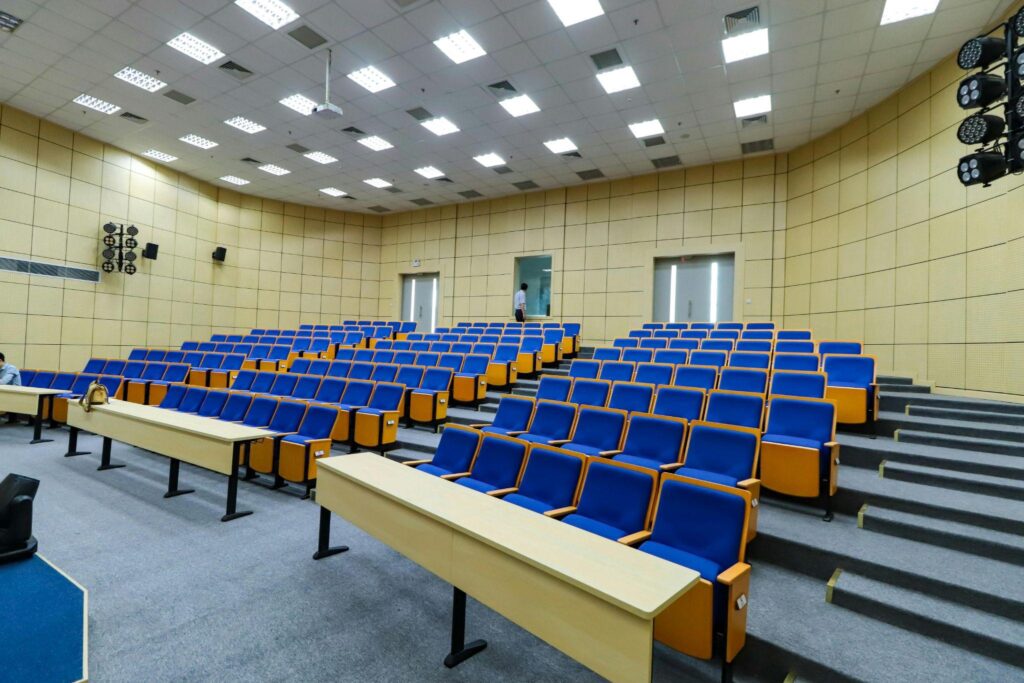
Large windows, hard floors, and plastered ceilings are common in UK schools, but they are also perfect “sonic mirrors”. To combat this, many modern institutions are investing in professional-grade acoustic tiles for walls in schools and classrooms.
By absorbing the sound rather than reflecting it, these tiles lower the ambient noise floor. This makes it significantly easier for students to enter a “flow state” during literacy hours.
Common Signs Your Reading Space Has Poor Acoustics
You might not realize your room is the problem until you know what to look for. Here are a few signs that your space is hindering your progress:
- The Clap Test: Stand in the middle of the room and clap your hands once. If you hear a ringing or a distinct “zing” afterward, you have a flutter echo.
- Fatigue: You feel disproportionately tired after only 20 or 30 minutes of reading.
- Sensitivity: Small sounds, like a clock ticking or a heater humming, feel unusually intrusive or loud.
- Hollow Sound: The room feels “cold” or hollow, similar to how a bathroom sounds.
The Impact on Reading Retention
When you read in a space with balanced acoustics, your heart rate remains steady, and your focus narrows. In an echoey room, your nervous system stays in a state of low-level “alertness,” scanning for the source of every reflected sound. This prevents you from reaching the “deep reading” state required for complex material.
How to Optimize Your Environment for Better Reading
If you want to get through your TBR (To-Be-Read) pile faster, consider these steps to improve your room’s sound quality:
- Introduce Softness: Soft furnishings like rugs, heavy curtains, and upholstered chairs are great at absorbing high-frequency sounds.
- Use Your Books: Large bookshelves filled with books are actually excellent sound diffusers. They break up flat wall surfaces, preventing sound from bouncing straight back at you.
- Targeted Absorption: In spaces where focus is the priority, such as a home office or a school library, the installation of acoustic tiles for walls in schools and classrooms provides the most consistent results. These are designed to target the specific frequencies of the human voice and ambient background noise.
- Strategic Positioning: Try to position your reading chair away from large, bare walls or windows.
“Effective reading isn’t just about the words on the page; it’s about the silence between them. When we control our auditory environment, we reclaim our focus.”
Acoustic Design in UK Education: A Productivity Shift
Across the UK, educators are recognizing that the “physicality” of a classroom directly impacts learning outcomes. A room that echoes makes students more restless and irritable.
By integrating acoustic tiles for walls in schools and classrooms, schools are creating “sanctuaries of focus”. These improvements don’t just help with reading; they reduce teacher vocal strain and improve the overall wellbeing of everyone in the room.
When the room is quiet and the acoustics are controlled, the “signal” (the teacher’s voice or the student’s internal reading voice) becomes much clearer relative to the “noise”.
Final Thoughts
If your reading progress has stalled, don’t be too hard on yourself. Look at the walls around you. By making a few small changes to the acoustics of your space—whether that’s adding a rug or installing dedicated acoustic panels—you can transform your reading experience from a chore into a joy. Remember, a peaceful room leads to a productive mind.
Frequently Asked Questions
Why can’t I just use noise-canceling headphones?
Noise-canceling headphones are great for blocking out steady drones (like an airplane engine), but they don’t solve the problem of “room feel”. Poor acoustics can be felt through the body, and many people find reading with headphones for long periods to be physically uncomfortable or isolating.
Are acoustic tiles difficult to install in a home or classroom?
Not at all. Modern acoustic tiles are lightweight and often come with self-adhesive backings or simple mounting clips. They can be arranged in creative patterns to double as wall art while performing a vital function.
What is the difference between soundproofing and sound absorption?
Soundproofing is about stopping sound from traveling from one room to another (e.g., stopping your neighbor’s music). Sound absorption improves sound quality in a room by reducing reflections from the walls. For better reading focus and absorption, absorption is usually the priority.
Will acoustic tiles make the room completely silent?
No, and you wouldn’t want them to. A “dead” room with zero sound can feel oppressive. The goal of using acoustic tiles for walls in schools and classrooms is to achieve a “balanced” room where sound is clear and reflections are controlled, not eliminated entirely.