
Lewis Carroll got it wrong. The story we have of a young girl tumbling down a rabbit hole into a world of whimsy was, in fact, the twisted testimony of an exiled princess who fled to her world after her evil aunt seized the throne of Wonderland in a bloody coup.
That is the premise of Frank Beddor’s best-selling series The Looking Glass Wars, which transforms Alice’s Adventures in Wonderland into an action-packed YA coming-of-age story. But Beddor didn’t just focus on the writing. A film producer (There’s Something About Mary) as well as an author, he understood the power of images in building a world.
Over the past twenty-five years, Beddor has collaborated with some of the most accomplished and important artists in entertainment, establishing a visual language that spans three novels, eight graphic novels, a video game, a tabletop game, and many more projects in development.
Here are the top 10 artists who helped shape The Looking Glass Wars universe:
Doug Chiang
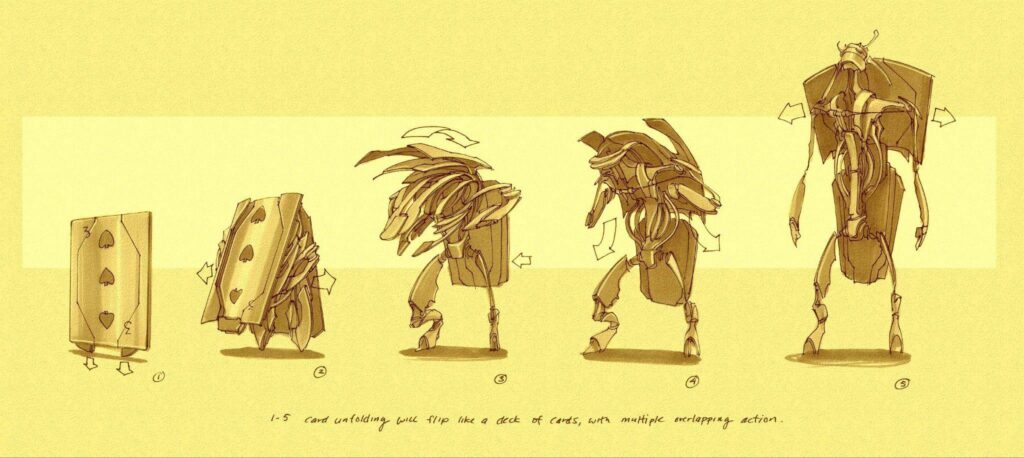
The Executive Creative Director of Lucasfilm was the first person Beddor worked with on the art for The Looking Glass Wars. Chiang created the original card soldiers design that was used as the cover for the US version of The Looking Glass Wars. The Academy Award-winner has played an integral role in shaping the look of Star Wars in the twenty-first century. He was the design director for the prequel trilogy and served as the production designer for The Mandalorian and Rogue One. Fun fact: He discovered Chris Appelhans, who’s also on this list.
Ryan Meinerding
The current Head of Visual Development at Marvel Studios has been defining the look of the cultural juggernaut since designing Iron Man’s armor for the first film. He’s also designed Captain America’s suit and worked on Thor, Spider-Man: Homecoming (his favorite superhero), and Black Panther. In 2024, Marvel released an art book celebrating his work, Marvel Studios: The Art of Ryan Meinerding. For The Looking Glass Wars, Meinerding created the first images of Alyss as a warrior queen, defined the look of her heroic beau, Dodge Anders, and contributed to the design of Wonderland’s Crystal Continuum travel network.
Chris Appelhans
The second Academy Award winner on this list, Chris Appelhans’ portfolio was discovered by Doug Chiang, who helped him get a job at ImageMovers, Robert Zemeckis’ company. As a designer and artist, Appelhans has worked on Coraline, Fantastic Mr. Fox, and Puss in Boots. But his best-known work is the 2025 Oscar-winning cultural phenomenon KPop Demon Hunters, which he wrote and directed with Maggie Kang. For Beddor, Appelhans created the look of young Alyss, balancing vulnerability and dignity with perfection, and contributed to the visual identity of the series’ villain Queen Redd.
Bill Sienkiewicz
Comics legend Bill Sienkiewicz created perhaps the most popular image in Beddor’s Wonderland canon – his portrait of Alyss’ loyal bodyguard Hatter Madigan, which impeccably captures Hatter’s essence as a character out of place and out of time. Sienkiewicz proved that comics could be fine art with his work on Moon Knight, Elektra: Assassin, and Daredevil. But Sienkiewicz isn’t the only artist in his family. He’s a descendant of Nobel laureate Henryk Sienkiewicz, whose international bestselling novel Quo Vadis was the basis of the classic MGM film of the same name.
Brom
The defining voice of dark fantasy illustration, Brom created the delightfully creepy look of Queen Redd’s minions, the Glass Eyes. Brom has touched every medium you can think of – novels (The Child Thief, which he also wrote), film (Galaxy Quest, Sleepy Hollow), video games (Doom, Diablo, World of Warcraft), and tabletop games (Magic: The Gathering). In 2014, Black Gate magazine included him in their list of The Top 10 RPG Artists of the Past 40 Years, calling him, “…one of the greatest pure fantasy talents of his generation.”
Ben Templesmith
One of the most uncompromising and distinctive visual voices in comics, Templesmith co-created 30 Days of Night with Steve Niles. The comic book miniseries became a breakout success and spawned a multimedia franchise, including over 15 comic books, 6 novels, and a 2007 feature film adaptation produced by Sam Raimi and starring Josh Hartnett. In 2006, Templesmith teamed with Beddor and writer Liz Cavalier for the first volume of the Hatter M graphic novel series. Templesmith’s moody, darkly beautiful work set the tone for the five books that would follow and was nominated for an Eisner Award.
VincentProce
Discovered by Guillermo del Toro, Vincent has been the creature designer and concept artist behind some of the most visually arresting dark fantasy work in film and television — including the Oscar-winning The Shape of Water, the It and Smile franchises, and The Boys. For The Looking Glass Wars, Price illustrated the covers for three of the Hatter M graphic novels, as well as the covers of the graphic novel sequels to the original trilogy, Crossfire and Underfire.
Stephan Martiniere
Hugo Award-winning concept artist Stephan Martiniere created the most popular renditions of Beddor’s card soldiers and also contributed to the designs of Alyss and Wondertropolis, Wonderland’s capital city. Martiniere began his career in animation, directing episodes of Where’s Waldo, Dennis the Menace, and Madeline. He later worked as a concept artist on the films I, Robot, Guardians of the Galaxy, and Aquaman. Martiniere has also made his mark on theme parks, contributing to Universal’s Jurassic Park ride and Disney’s Avatar: Navi Journey. Over his forty-year career, Martiniere has established himself as an industry legend whose fingerprints are on the visual language of popular culture.
Maciej Kuciara
A bridge between gaming and cinema, the Emmy-winner has worked on some of the most visually ambitious properties of the last decade. He began his career in video games, providing concept art for the iconic The Last of Us series before working on such blockbuster films as Guardians of the Galaxy, Captain America: Civil War, and Spider-Man: No Way Home. His work on The Looking Glass Wars franchise includes one of the most popular renditions of Hatter Madigan and the cover for the middle-grade prequel novel, Hatter Madigan: Ghost in the H.A.T.B.O.X.
Vance Kovacs
A master of sweeping, cinematic imagery, Vance Kovacs’ film work includes the photorealistic remakes of The Jungle Book and The Lion King, and a host of Marvel properties such as Black Panther and Guardians of the Galaxy Vol. 3. He has also contributed to the God of War and Rift video game franchises and Dungeons and Dragons. His work on The Looking Glass Wars spans a wide range of subjects, including Redd’s fearsome assassin, The Cat, the royal suit families, and the cover for the second book in the original series, Seeing Redd.
To get exclusive access to Looking Glass Wars news and content, join the VIP Facebook Group.