
A property manager wants to showcase an apartment to distant tenants. A museum curator needs to make collections accessible beyond visiting hours. A travel company wants to preview destinations before clients book. These scenarios share a common need: creating visual tours of physical spaces without expensive production crews. Text to video generation transforms space visualization by allowing simple descriptions to become navigable tours.
Dreamina’s Seedance 2.5 model was built to understand spatial progression and environmental coherence, translating text descriptions into tour footage that guides viewers through spaces with natural flow and comprehensive understanding.
Why virtual tours matter beyond real estate
Virtual tours extend far beyond property sales. Museums reach global audiences. Hotels showcase amenities. Educational institutions help prospective students experience campuses. Archaeological sites provide impossible-in-person access. This expansion means tours serve different purposes requiring tailored approaches. A real estate tour prioritizes showing property condition. A museum tour prioritizes cultural experience. Text to video allows each purpose to be served specifically.
The challenge of spatial clarity
Viewers need to understand spatial relationships in tours. How do rooms connect? What’s actual size? Where are exits? Sequential video can create confusion about layout. Text to video solves this by designing tours with spatial logic foremost. A prompt can specify logical progression that maintains viewer orientation through spatial landmarks, helping viewers develop genuine understanding rather than viewing disconnected rooms.
Scale and proportion communication
Virtual viewers need to understand actual space scale. A room that looks large in video might be deceptively small. Including human figures helps establish scale, but describing spatial relationships precisely is essential. A prompt noting “how proportions create specific feeling with scale clearly communicable through how figures inhabit space” prevents misleading impressions.
Narrative flow in spatial exploration
The best tours guide viewers through spaces with intentional pacing and progression. A tour might begin with an overview establishing context, then move into details. That narrative structure transforms tours from documentation into experiences. Text to video allows pacing designed deliberately, where progression feels guided rather than random.
Authenticity in tour presentation
Tours fail when they feel overly produced or misleading. Viewers sense artificial enhancement or staging. The most effective tours balance professional presentation with authenticity, showing spaces as they genuinely are while presenting them favorably. Text-to-video supports authentic presentation through descriptions grounded in actual conditions, creating confidence that what’s shown represents reality.
Accessibility through comprehensive visualization
Virtual tours democratize access. Someone unable to travel experiences distant spaces. A person with mobility limitations explores sites independently. A student tours potential universities. That accessibility extends possibilities profoundly. A farmer can virtually tour equipment before purchasing. That opportunity expansion matters significantly.
Different tour approaches for different purposes
A residential tour emphasizes livability. A commercial tour emphasizes functionality and capacity. A cultural tour emphasizes historical significance. A hospitality tour emphasizes atmosphere. Each requires different emphasis and pacing. Text to video allows these approaches to be tailored specifically rather than forcing one style across contexts.
Navigating Through Space: Your Virtual Experience
Step 1: Map your space and write your tour prompt
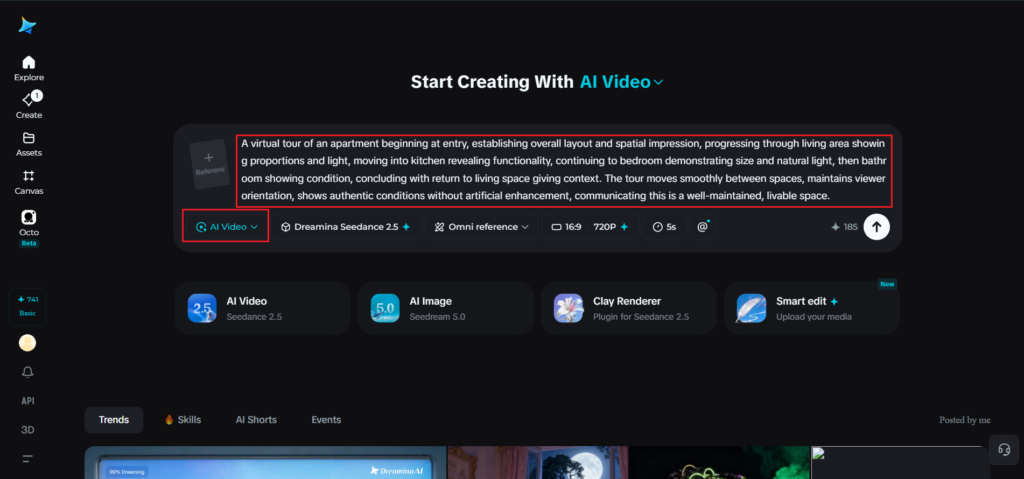
Visit Dreamina, sign in, and head to the “AI Video” section. Understand your space’s layout and logical progression. Click “Add reference image” if you have photos. Write your tour prompt describing the complete tour experience from entry through conclusion, including spatial progression, key features, how scale communicates, and overall tone.
A detailed prompt for 60-90 seconds might read: A virtual tour of an apartment beginning at entry, establishing overall layout and spatial impression, progressing through living area showing proportions and light, moving into kitchen revealing functionality, continuing to bedroom demonstrating size and natural light, then bathroom showing condition, concluding with return to living space giving context. The tour moves smoothly between spaces, maintains viewer orientation, shows authentic conditions without artificial enhancement, communicating this is a well-maintained, livable space.
Step 2: Generate your virtual tour with Seedance 2.5
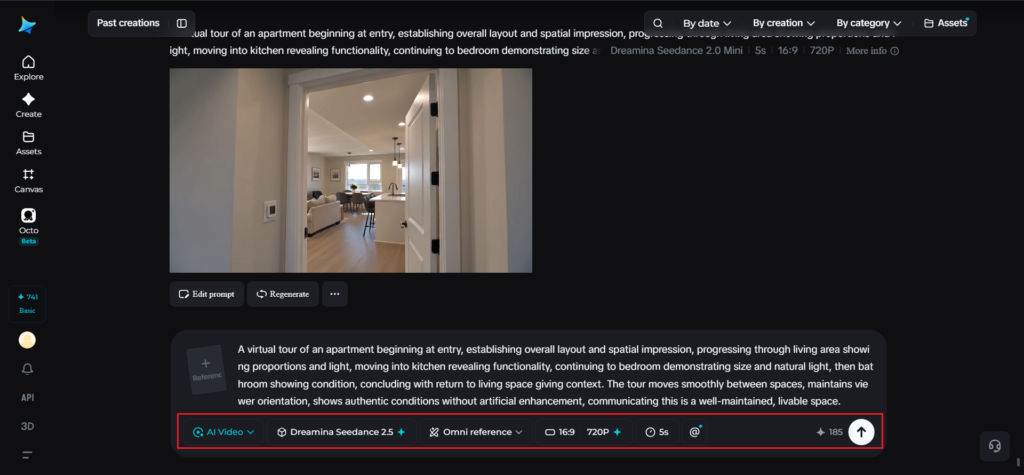
Select the Seedance 2.5 model. Choose 60-120 seconds depending on space complexity. Pick 16:9 for real estate contexts or 9:16 for mobile viewing. Click Dreamina’s generation icon and watch your described space become navigable tour.
Step 3: Polish navigation and finalize
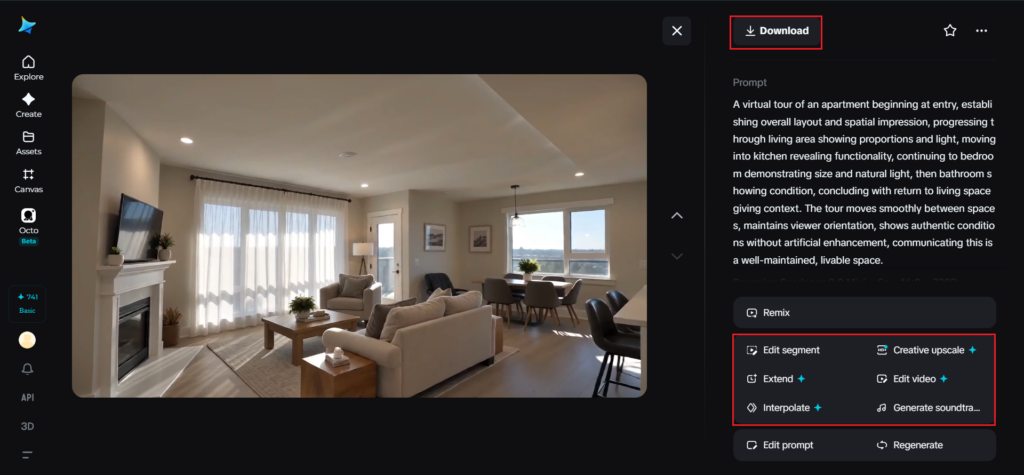
Use Dreamina’s AI editing tools to enhance clarity. Upscale sharpens spatial details and architectural elements, while Generate Soundtrack adds appropriate ambient audio. Review tour confirming spatial progression feels logical, scale is clearly communicated, and viewers develop genuine understanding. Export and share.
Seedance 2.5’s Tour-Rendering Excellence
Seedance 2.5 was engineered specifically to render virtual tours with spatial coherence and navigational clarity.
Spatial coherence across sequential spaces
The model maintains consistent spatial relationships as tours progress through multiple areas. Spatial landmarks remain consistent. Viewer orientation is preserved. Tours communicate how different spaces connect, preventing disorientation and maintaining logical flow.
Scale communication through contextual elements
The model understands how to communicate actual dimensions through context. Human figures establish proportion. Objects convey scale. Movement through space conveys distance. Viewers develop accurate spatial understanding rather than misleading impressions.
Natural progression and navigational clarity
The model renders tour progression that feels guided rather than random. Transitions flow naturally. The tour path communicates logical navigation. Viewers understand how to mentally move through spaces after touring concludes.
Lighting that shows spaces authentically
The model renders natural-looking lighting presenting spaces professionally without artificial enhancement. Viewers see spaces as they genuinely appear while being presented favorably. That authenticity builds confidence in what’s shown.
Extended duration for comprehensive exploration
Ultra-long Video Generation reaches 180 seconds, allowing complete tours of substantial spaces. Viewers experience comprehensive exploration rather than abbreviated fragments, developing genuine spatial understanding.
When spaces become accessible experiences
Virtual tours succeed when they convey spatial experience rather than just showing disconnected views. With Dreamina and its Seedance 2.5 model, spaces described in text become tour footage that guides viewers through environments with spatial clarity and navigational logic.
Dreamina allows text-to-video to democratize space accessibility and make comprehensive virtual experiences available to anyone, anywhere.