
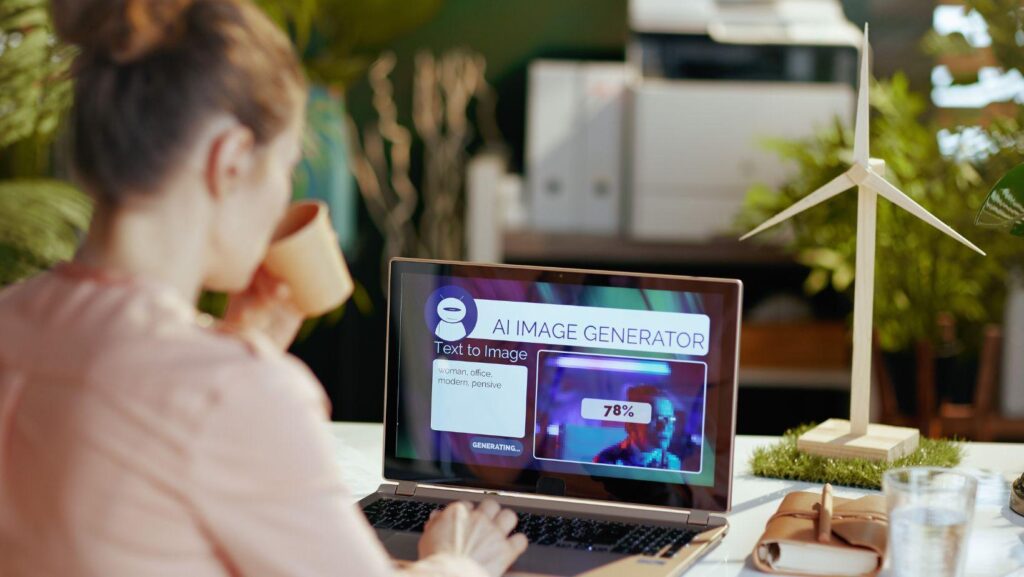
Generative artificial intelligence has become part of the technology stack available to entrepreneurs developing products in renewable energy, climate technology, sustainable retail, recycling, agriculture, and other environmentally focused sectors. Generative AI systems can produce text, software code, images, summaries, structured data, and other digital outputs from user instructions.
For green entrepreneurs, these capabilities create a measurable trade-off. AI can reduce the labor and time required for several business processes, while the computing infrastructure behind AI consumes electricity and requires data-center equipment. The International Energy Agency (IEA) reported in 2026 that electricity consumption from AI-focused data centers increased by 50% in 2025.
AI Reduces Some Startup Development Tasks
Generative AI can perform activities that previously required manual work or specialist software. An OECD review published in 2025 found evidence that generative AI can affect productivity, innovation, and entrepreneurship through task automation, skill enhancement, idea generation, research and development, and lower barriers to business entry.
Entrepreneurs can use generative AI for specific startup activities, including:
- Summarizing market and technical research.
- Drafting website and product copy.
- Producing software code and documentation.
- Generating initial visual concepts.
- Preparing customer-support materials.
- Creating structured comparisons of competitors.
- Drafting internal documents and investor materials.
These applications can be used by climate-focused startups as well as businesses in other industries. Research examining the rollout of GitHub Copilot found that more-exposed startups reached initial funding rounds faster and used fewer software developers than comparable startups after the tool became available.
Generative AI does not eliminate other steps involved in establishing a digital business. A company still needs a web address if it intends to operate through its own domain. A domain names search can be used to determine whether a proposed domain is available before a business builds its website around that address.
AI Can Shorten the Route From Concept to Launch
AI-assisted development affects more than writing. Coding assistants can generate application code, database queries, tests, documentation, and API integrations. Image-generation systems can produce interface concepts, illustrations, advertising graphics, and presentation materials.
These functions allow multiple pre-launch activities to occur with fewer manual production steps. A detailed description of how generative AI is compressing the startup timeline identifies research, programming, documentation, design, testing, marketing preparation, and customer-support preparation as activities affected by generative AI.
Human verification remains necessary. Generative AI systems can produce incorrect factual statements, faulty code, inaccurate calculations, and erroneous legal interpretations. The OECD has also identified trust, human expertise, and users’ understanding of AI limitations as relevant constraints on effective adoption.
AI Infrastructure Consumes Electricity
The environmental issue for green entrepreneurs originates partly in the infrastructure required to operate AI systems. AI models run in data centers containing computing, networking, storage, cooling, and electrical equipment.
IEA data show the scale of this infrastructure:
- Global data-center electricity demand increased by 17% in 2025.
- Electricity consumption from AI-focused data centers increased by 50% during the same year.
- The capacity of advanced data centers specifically designed for AI more than tripled during an 18-month period covered by the IEA’s 2026 assessment.
- New AI applications involving video generation, reasoning, and agentic tasks can require hundreds or thousands of times more energy per query than simple text generation.
Energy use per AI task has simultaneously declined. The IEA reported in 2026 that software and hardware improvements had reduced energy consumption per AI task by at least an order of magnitude annually in recent years. Consequently, the electricity impact of AI depends on efficiency improvements, total usage, model size, workload type, and the electricity sources supplying data centers.
AI Also Has Applications in Energy Efficiency
The relationship between AI and environmental performance is not limited to electricity consumption. AI is already used in energy systems to optimize operations, improve efficiency, reduce costs, increase equipment uptime, and support emissions reductions.
The IEA has documented applications of AI in increasingly electrified, connected, and decentralized energy systems. AI can process operational information and support optimization in systems where large quantities of data make manual analysis difficult.
The technology’s role in clean-energy innovation remains comparatively limited. IEA analysis found that approximately 1% of energy-related patents reference AI as part of the patented innovation, with similar proportions across fossil-fuel and clean-energy technologies.
Green Businesses Face a Quantifiable Trade-Off
The relationship between green entrepreneurship and generative AI therefore contains two measurable components. Generative AI can reduce time and labor requirements for research, software development, documentation, design, and other startup activities. Its operation also contributes to electricity demand from data centers.
For an environmentally focused company, the relevant variables include:
- The number and type of AI tasks performed.
- Whether text, image, video, reasoning, or agentic models are used.
- The computational efficiency of the selected models.
- The electricity mix supplying the data centers processing those workloads.
- Whether AI use produces measurable reductions in energy consumption, material use, travel, development time, or other operational inputs.
Generative AI therefore functions as both a productivity technology and an electricity-consuming digital service. For green entrepreneurs, those two documented characteristics exist simultaneously.