
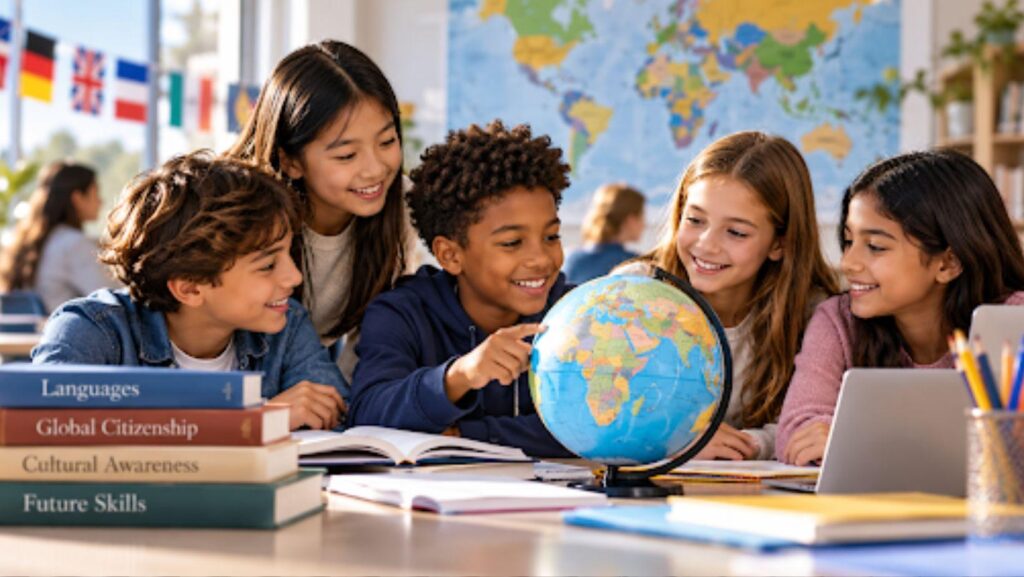
Children don’t need passports to interact with the wider world nowadays. Many young people already engage through travel, school, and friendships. Thanks to social media, immersion in the global village is certainly possible. As a result, international education is incredibly relevant today. At its best, it offers so much more than a stock-standard curriculum. It changes the company children keep while they’re busy learning and prepping themselves for life beyond school. Different languages, customs, and viewpoints become part of daily life. That experience shapes how children see others. And it’s so much more important and meaningful than people believe.
A Classroom That Truly Feels Like a Global Village
International classrooms often bring many diverse nationalities together. For children, that mix of people can feel normal quickly. One friend may speak two languages at home. Another may have already lived in three different countries. These intricacies create plenty of small learning moments. And remember, not every lesson comes straight from a textbook. Sometimes it comes from hearing another person’s story. That’s meaningful interaction, and people genuinely appreciate it.
Children begin noticing how differently families live and communicate. They also learn that disagreement does not always mean conflict. That is useful knowledge at any age. In fact, getting to air your differences in a respectful manner is part of what it means to fit into society. The academic side matters just as much. Many schools follow British, American, or International Baccalaureate programs. These pathways can suit families with international university plans.
They can also help families expecting another overseas move. And so we begin a pathway to learning, development, immersion and engagement.
Learning How to Handle Difference
Good grades obviously count for something. However, adulthood asks for plenty that examinations simply cannot measure. Young people need to listen properly. They need to explain ideas without talking over others. And that’s an important point in a world where everyone is trying to drown out everyone else’s voices. Students also need some comfort with change. A mixed classroom gives those skills room to develop. Fortunately, international schools can offer the foundations for lifelong learning, societal integration, and future success.
As a case in point, group projects can include several cultures and disparate communication styles. That sometimes makes teamwork a little harder. It can also make the outcome and the process more interesting. Language learning fits naturally into this environment. Many international schools teach a second language from early grades. Some offer bilingual teaching across several subjects. Students with bilingual or multilingual abilities tend to fare better in the global milieu.
Regular exposure to other cultures makes another language feel less foreign. Digital skills are equally important. Students research, create, present, and communicate online with one another. Those habits routinely connect them with people well beyond their campus. The levels of digital proficiency with the younger generation are well beyond anything that our cultural zeitgeist has ever experienced. And the trend is clearly continuing on that same trajectory.
Finding the Right School
Of course, international schools are not all alike. A famous name does not guarantee the right fit. Parents should start with their child’s actual needs. Curriculum is important, but daily school life matters too. Look closely at class sizes, support, activities, and teaching quality. A welcoming community can make a difficult move much easier. That deserves real attention when a family has recently relocated. Remote work can mean remote learning or relocation to new towns and cities abroad.
Parents exploring the best international schools worldwide can easily narrow their choices online. That makes the first round of research far more manageable – and less stressful. It also leaves more time for deeper questions later. A school visit remains valuable whenever possible. Websites show facilities, programs, and smiling students. They rarely show how a school actually feels. Talking with teachers and current families can reveal much more. That’s why an in-person experience is sacrosanct.
What Children Carry Forward
A standard global education does not guarantee a particular type of future. No school can really promise that. Its value often appears in other ways. Children become less uneasy around unfamiliar people and places. They learn to ask questions before making assumptions. They become more willing to consider another viewpoint. Those habits travel well.
University may take them abroad. Work may connect them with colleagues across several countries. Life itself may lead somewhere completely unexpected. A broad education cannot prepare children for every change. It can make change feel less frightening. That is a useful foundation for any connected future. And the friendships that are cultivated along life’s journey serve students well throughout.