

And someone might now think: wait, I had no idea my library needed gambling books. It is important to remember that gambling is its own separate category in this context, while poker has a different role, one that goes deep into the nature and logic of the game.
There is no exact data, but the vast majority of poker books fall under the category of self-help literature, because many authors aim to teach emotional control, reading the room, and more through the game. Often, the best authors in this sense are current or former poker players. With this being said, there are several reasons why we need more books on poker.
Why phone-first play changed the kind of books readers need
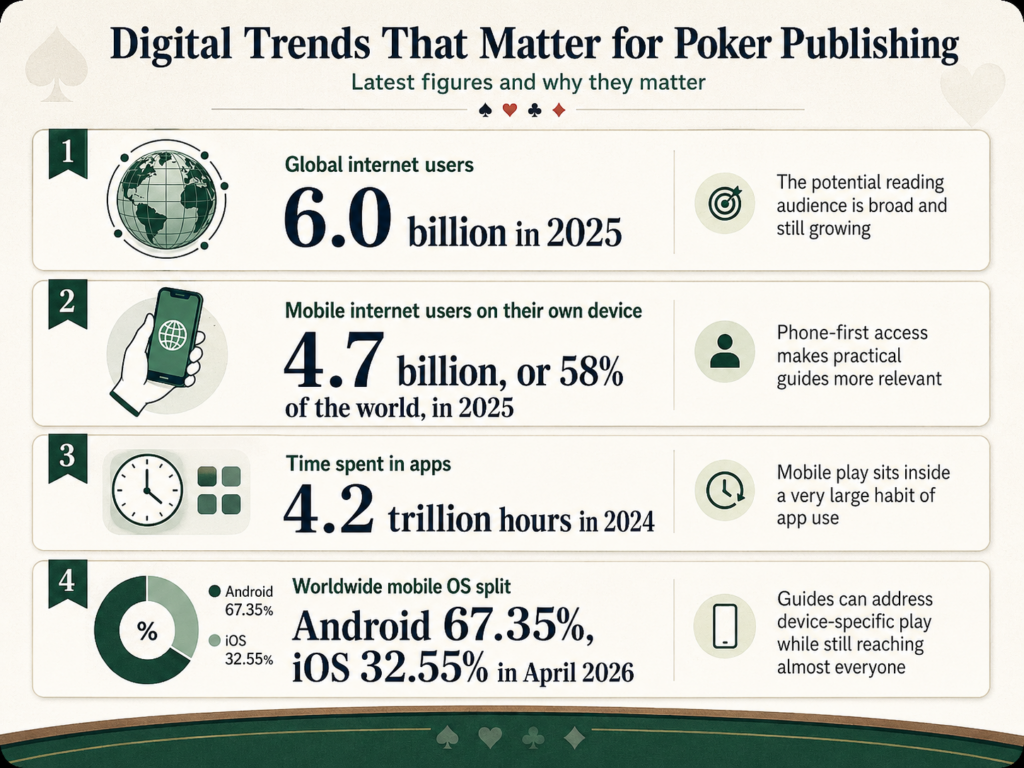
The most important shift is not simply that poker became digital. It is that mobile poker turned play into something immediate, frequent, and widely available. That changes the reading market. When access to a game becomes a few taps away, curiosity becomes practical. A reader who might once have bought a memoir for atmosphere now has a stronger reason to want a guide that explains structure, pace, hand reading, and session habits.
This is where the subject becomes especially interesting for publishers and for serious readers. A phone-based table is still the same game in its bones, but the experience around the decisions is different. Information is compressed. Attention is tested in shorter bursts. Bet entry, note keeping, and table reading happen through a smaller frame. Even the rhythm of a session changes, because many players now meet the game in spare moments rather than in one long sitting. A book that responds to that environment would not feel narrow. It would feel timely.
Mobile play creates demand for a different kind of guide
That is why mobile poker should be central to the next wave of poker books. The demand is no longer only for stories of success, dramatic biographies, or broad inspiration. There is also a clear place for manuals that teach how to think on a smaller screen, how to review hands after brief sessions, how to keep decision quality steady when play is broken into fragments, and how different operating systems can shape the feel of the game without changing its logic. In other words, readers can now want both narrative and method.
A better shelf for a faster game
The strongest argument for more poker books is simple. Books do something apps cannot. They organize experiences. They take scattered hands, half-remembered mistakes, and vague instincts, then turn them into a structure a reader can return to. That is especially useful when the game now reaches people through phones, because speed creates exposure, but books create understanding.
The next good poker book does not have to choose between literary value and practical use. It can have both. It can explain why position matters, why hand histories deserve close reading, and why a brief session still produces material worth studying. For book readers, that is a familiar pleasure. It is the pleasure of moving from event to meaning. A good poker guide belongs on the shelf for the same reason a good book of essays or criticism does. It helps readers notice more the next time they return to the text, or in this case, the table.
Poker books are really books about judgment
There is also a larger reason these books deserve more space. Poker writing, at its best, is not only game writing. It is writing about judgment under pressure. That gives it a reach beyond the players who study charts or replay hands. Annie Duke formulates the point in the plainest possible way: “Everything is a bet.” That line is short, but it explains why poker belongs so naturally in book culture. It turns the game into a model for how people read risk, weigh evidence, and live with uncertainty.
Readers still make space for books they can use again and again. Publishers Weekly reported that print book sales reached 762.4 million copies in 2025, a little higher than in 2024.
A good poker book can belong on that shelf because people return to it many times. You might read it again after a game, after a mistake, or after a lucky win that feels less smart when you think about it later. More poker books would not be in excess. They would answer a real reading need. The game has become easier to reach, and that is exactly why the shelf should become deeper.
Beyond gambling, towards self-growth
One strong reason to publish more poker books is that poker teaches people how to read others.
A serious poker hand is not only about numbers or memory. It is also about asking:
- What does the other person believe?
- What do they want me to believe?
- How will my own actions change what they do next?
That is why researchers use poker when they study social decision-making. One review says poker bluffing tasks can help scientists understand how people predict what others are thinking. Some research also found that when people tried to guess if an opponent was bluffing, the brain reacted differently when the opponent was a real human instead of a computer.

Differences in social and nonsocial decision-making processes, presented by Frontiers.
In simple words, poker makes people pay attention not just to the cards, but also to other people’s minds. As we presented the human brain scan showing social and nonsocial decision-making, it is also worth mentioning that the appeal of poker comes down to its social nature. Even a simple vox pop may show how interested people can be in a game called poker, and of course, many of them can be among the readers of poker books:
View this post on Instagram
More than game strategy
That makes poker books valuable in a way many game manuals are not. They can teach readers how communication works below the surface. Research in Nature Communications reported findings from four studies involving 115 listeners and found that judgments of certainty and honesty in speech rely on a common prosodic signature across pitch, duration, and loudness. That matters for poker because strong books can explain that table communication is rarely contained in the words alone.
Good poker books may help readers build a better frame
A study in Organization Studies adapted frame analysis to a poker-based experiment and found that people’s frames shape what they notice, how they interpret it, and how they combine it into a decision. That sounds very close to what a good poker book does for its reader. It teaches how to build a better frame for the room itself, so that communication, silence, tempo, and reaction all become part of the text being read.